“Trust in the Lord with all your heart and lean not on your own understanding.” — Proverbs 3:5–6
You can’t control the ocean.
You can study the tides. You can read the swell forecasts. You can position yourself perfectly in the lineup and time your paddle stroke to the second. And still — the wave does what the wave does. It lifts you or it swallows you. It carries you to shore or it holds you under. And the only thing you can do about it is decide how you respond.
This is the first lesson the ocean teaches, and it’s the one most of us resist the hardest: you are not in charge.
The Illusion of Control
Most of us spend our lives building systems of control. We plan. We prepare. We optimize. We create the illusion that if we just work hard enough, think clearly enough, and execute well enough, we can eliminate uncertainty.
And then the ocean laughs.
Not cruelly. Gently. The way a parent might smile at a child who insists they don’t need help crossing the street. The ocean doesn’t punish your desire for control — it simply makes it irrelevant. You can’t negotiate with a wave. You can’t outthink a current. You can only surrender to the reality that something bigger than you is moving, and your job is to move with it.
This is what Proverbs 3:5 means when it says “lean not on your own understanding.” It’s not telling you to stop thinking. It’s telling you to stop believing that your thinking is enough. There is a current beneath the surface of your life that you didn’t create and can’t redirect. God is moving. Your job isn’t to steer — it’s to trust.
What Surrender Looks Like in the Water
At Surf + Soul, Day 1 of every retreat is themed around Surrender. And the very first thing guests do — before any coaching, any technique, any instruction — is walk into the ocean together.
No boards. No rashguards. Just a group of people standing waist-deep in the Pacific, waves hitting their chests, salt on their lips, and the sound of the water drowning out everything they brought with them — the work stress, the inbox, the performance anxiety, the social awkwardness of being surrounded by strangers.
The instruction is simple: stand here. Close your eyes. Let every wave that hits you wash something off.
Two minutes of silence in the ocean will do more for your soul than two hours of trying to think your way to peace. Because surrender isn’t a thought — it’s a posture. It’s the physical act of being held by something you can’t see, can’t control, and can’t fully understand.
That’s faith. Not the Sunday morning version where you nod along with the sermon. The chest-deep, salt-in-your-eyes, wave-hitting-your-body version. The one that feels like drowning and deliverance at the same time.
The Paddle Out
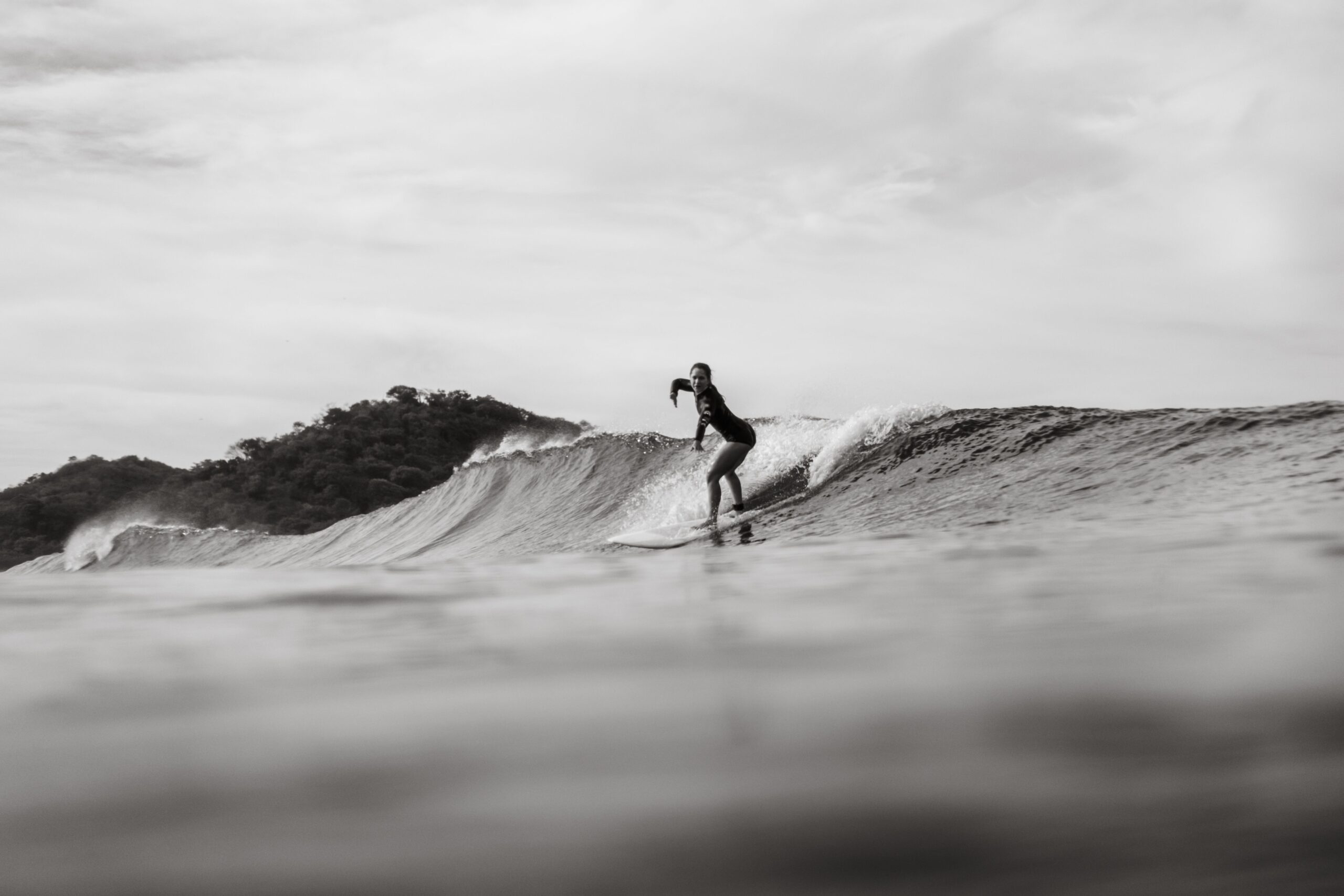
There’s a moment in every surfer’s first session where they have to paddle past the breaking waves to reach the lineup. It’s called the paddle out, and it is an act of surrender disguised as effort.
You paddle hard. A wave hits you. You paddle again. Another wave. Your arms burn. Your chest scrapes the board. Salt stings your eyes. And the shore — the safe, dry, controllable shore — gets further away with every stroke.
Every instinct says turn around. Every muscle says stop. And the only thing that keeps you going is the belief that there’s something worth reaching on the other side.
This is what faith looks like. Not the kind of faith that lives in your head — the kind that lives in your arms, your lungs, your decision to keep paddling when everything in you wants to quit.
Hebrews 11:1 says faith is the substance of things hoped for, the evidence of things not seen. The lineup is out there. You can’t see it from where you are. But you paddle anyway. That’s surrender. That’s faith. That’s the whole point.
Why We Resist It
We resist surrender because we confuse it with weakness. In a culture that worships self-reliance, independence, and control, the idea of letting go feels like losing.
But the ocean teaches a different definition. In the water, the surfers who fight the wave are the ones who get hurt. The ones who go rigid, who try to overpower the force, who refuse to fall — they’re the ones who come up gasping, bruised, and disoriented.
The ones who surrender — who relax their body, trust the buoyancy, and let the wave pass through them — come up smiling. They don’t fight the hold-down. They let it happen. They trust the surface. They rise.
Grace is the surface you always rise to. The ocean knows this. The question is whether you believe it.
Taking It Home
The ocean doesn’t stay in Nicaragua. The lesson of surrender follows you home — to the job that feels out of control, the relationship that won’t bend to your will, the diagnosis that shattered your plan, the season of life that doesn’t match what you expected.
Proverbs 3:5 doesn’t say trust in the Lord with all your heart when it’s convenient. It says trust with all your heart. Period. Lean not on your own understanding. Not because your understanding is bad — but because it’s not big enough.
The ocean is bigger than you. God is bigger than the ocean. And surrender isn’t giving up — it’s giving over. It’s the decision to stop white-knuckling the steering wheel and let the current carry you where you were always meant to go.
That’s what the ocean teaches. Every single day. To anyone willing to get in the water and listen.
The ocean is our church. Courage is worship. Community is calling.
Surf + Soul retreats begin every week with the Surrender Immersion — walking into the Pacific Ocean together and letting go of everything you carried in. Learn more at thesurfsoul.com.